 |
Subscribe / Renew |
 |
Contact Us |
| ► Subscribe to our Free Weekly Newsletter | |

Construction Bids
| home | Welcome, sign in or click here to subscribe. | login |


 print print  email to a friend email to a friend  reprints add to mydjc reprints add to mydjc |  |

February 9, 2000
|
Q: What kind of environmental engineering do you do for mining projects?
A: We work in both reclaiming abandoned or closed mines and planning new ones.
New mines really have to be planned in significant detail, down to having a reclamation plan and a cost estimate put together for the reclamation work even before a shovel of ore is extracted from the site.
A lot of the time, the reclamation will be done coincident with the operations.
Reclaiming a closed mine often involves rehabilitating adjacent wetlands, streams or creeks to get the site clean enough to support trout or other aquatic species.
Q: What local environmental cleanup trends do you see?A: We’re getting away from Superfund projects, which fit into an established process that the EPA has developed. What’s happening now in the Northwest is that a lot of the Superfund sites have been cleaned up, but there are other hazardous waste sites, such as pulp mills and mines, that are not classified as Superfund sites -- so there isn’t an established process. These non-Superfund sites are going to get cleaned up, but there’s no clear game plan.
It’s more challenging because there’s no cookbook, but it provides a lot more opportunity for innovation and meeting multiple stakeholder objectives.
Q: How competitive is the local environmental engineering market?
A: There’s a lot of consolidation going on in the industry, so at times we’re competing against very, very large firms. Right now, there is a lot of competition and maybe because of I-695. It may be that a lot of the firms that were focused on transportation might have decided to focus more on this field. I see some of the traditional engineering firms doing more environmental work -- they do that to implement their built projects or they may just feel they have to diversify to stay competitive.
Q: How much of your firm’s work is public?
A: Most of it. The regulatory process and the agencies’ objectives are such that sometimes these projects take a decade to implement from start to finish. We’re working with our clients to clarify their objectives, and sometimes we assist them in securing funds to implement the project. We then have to figure out which agencies need to be brought in and which stakeholders might have input. And we also do community outreach and public education. All of that’s before you get into the in-depth, technical aspects of it.
Q: How much do you rely on subcontractors?
A: Though we’re a small firm, we don’t have to bring in other engineers, for the most part, unless it’s for a particular specialty. Occasionally, we will subcontract to a geotechnical engineer. We manage most of our projects out of this office and carry it out from start to finish.
Q: What are your some of your firm’s recent projects?
A: The Omak Creek project involved opening up 30 miles of creek channel to steelhead migration and spawning. This part of the watershed in the Okanagan was closed off by barriers to fish passage at its mouth. The creek there had been routed via a 7-foot culvert under a working lumber mill that became a barrier to the steelhead, so what we did was reconstruct and relocate that stream channel along with constructing a low-profile arch through the mill facility.
This was also a neat project in terms of what it meant to the community, especially the Colville tribe, which has in interest in the fisheries in that watershed. All in all, it was very satisfying to work with the different stakeholders, it was a challenging schedule with a tight timeline, and it’s going to benefit the public by getting steelhead back to the watershed.
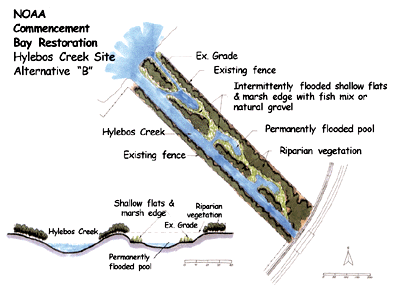
The Commencement Bay project in Tacoma is interesting because there are very limited habitat areas available for habit reconstruction and restoration. The area has been heavily industrialized, but there are some sites where habitat can be re-established. One of our projects there is at the mouth of the Hylebos Creek where there is an existing straight canal-type outlet. Three backwater pools will be constructed to provide for rearing for juvenile salmon.
The other project at Commencement Bay is the nursery site. That project is going to take stormwater drainage and use it as a fresh water source to grow native plants on the site. The native plants, in turn, will provide detritus and biomass as a food source in the intertidal zone of the bay. To me, it’s interesting biologically as well as from an engineering standpoint.
|
Q: Is the listing of salmon and other fish under the Endangered Species Act having an impact on your work?
A: It is having an impact on the projects we’re already working on. We’ve been working on this type of project for the last 10 years, but it just so happens that some of our project sites now have ESA listings associated with the species that use those areas. In the Coeur d’Alene basin, for example, which we started working on 10 years ago, the bull trout have been listed.
At Omak, the steelhead have been listed.
I think we’ll be in a good position because we’ve been working toward restoring natural resources for the last decade. I don’t think it will be new as far as the technical elements of the project, but what will be new are the players, the number of stakeholders and the permitting agencies involved.
Q: What’s one major challenge in the work you do?
A: What we’re really trying to do is to improve the environment, but we found that with these projects -- because these aren’t concerning the built environment -- we’re a little out of the box. There’s not really a process to easily permit projects for natural resource restoration. It’s a little out of the normal context of, say permitting a parking lot or permitting a building; there’s no physical structure, so it’s unique. We’re just starting to work a lot of these issues out with the agencies.
Q: What is your firm’s strategy for growth?
A: We’re trying to grow in a deliberate fashion. We like being small and being responsive to a few clients and serving those clients well because most of our projects are long-term as it is. But we have grown organically between 20-50 percent a year for the last eight years.
Q: What challenges have you faced as a woman in male-dominated profession?
A: I’m a mining and environmental engineer, and the mining field itself has been traditionally male-dominated. That, in a way, keeps it interesting and challenging, and I’m always looking for a challenge.
As a 20-year-old engineer at a coal mine, I did run into some foremen who really put me to the test. But, in a way, it was a good test to have to pass in the first few years on the job.
Growing up in Colorado, I had spent a lot of time recreating in the mountains and discovering old mine sites, and I started getting curious about mining in general and what the impacts might be. So, it seems to me I’ve come full circle from discovering those mines to now doing cleanup and restoration for those sites.
What I think is happening in our industry is the projects are so complicated and involve so many stakeholders, that they involve developing a collaborative team-type approach to solving them. I think women are probably very well suited to collaborative-type work and bringing people of different disciplines and different backgrounds together to solve problems. For me, it’s a natural extension of what I do everyday.
Q: Has the passage of Initiative 200 affected your firm’s work?
A: It hasn’t because the projects we’re working on were not funded from the state. Most of our projects are funded with federal dollars.
Q: Do you see yourself as an environmentalist?
A: I never classified myself as an environmentalist, but my heart is really in restoring mine lands or disturbed lands to uses that would achieve public good.
Previous columns:


