 |
Subscribe / Renew |
 |
Contact Us |
| ► Subscribe to our Free Weekly Newsletter | |

Construction Bids
| home | Welcome, sign in or click here to subscribe. | login |


 print print  email to a friend email to a friend  reprints add to mydjc reprints add to mydjc |  |

January 26, 2000
Journal Staff reporter
 |
Q: What do you enjoy about working on public projects?
A: What has been intriguing is working with clients who are not only meeting their own immediate needs but are having to work with the broader community. For example, with University of Washington work, there is the immediate constituency of the School Of Fisheries, but it fits within a larger context of a campus and the city of Seattle. Holly Park is an attempt to redevelop a portion of the city to provide housing - with some social service issues - economic redevelopment and revitalization. It’s not just physical design, there’s an important social component. I can knit whatever is being developed back into the surrounding community.
Q: What projects symbolize your firm’s work?
A: The first one, which is just starting, is the Civic Center open space system with Kathryn Gustafson. She is functioning as lead designer, and Swift & Co. is functioning in a support capacity. The project has a significant open space system within a governmental complex, surrounded by a changing community. It’s going to be important as something that serves the neighborhood as a series of open spaces but also serves the city. The opportunity here is to do something that everyone aspires to, which is design for an 18-hour day, if not more.
Q: What trends do you see for open space in Seattle?
A: What we are going to see in next three to four years is a real transformation of open space in the downtown area. I think that we are going to see a change, with the combination of the neighborhood planning efforts, with the green streets, with things like the plaza just north of the football stadium and with the aquarium redevelopment. I think we’re not only going to see new open spaces coming out but a greater attention to the street environment.
Q: Do you draw inspiration from other cities and their use of open space?
A: Seattle is a rather unusual situation. If you look for equivalencies in open spaces, what you find are open spaces significantly different from Seattle Civic Center. For example, if one were to look at Yerrba Buena Gardens in San Francisco, it has some of the grade change but it doesn’t have 70 feet of grade change. Also, it is not almost completely surrounded by government facilities. It has been an interesting challenge to identify any kind of equivalencies, and we’re not seeing any. One of the primary objectives is to have a vital, active urban open space which can be appropriated by people for individual events and very large events. We’re looking very hard at what it means to be a Seattle open space, and I don’t know the answer to that yet.
Q: Can you tell us about your completed projects?
|
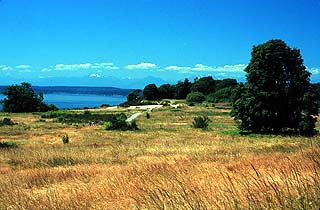
Another one which is different is a project we did at Discovery Park a number of years ago, a habitat improvement project. The city had $1 million to spend to upgrade the ecosystems of Discovery Park. What we did was look at the park from a landscape ecology perspective and said, ‘What are the moves that you can make in this park that will help establish a more sustained ecological situation that the city can maintain?’ We assessed the existing ecosystems and the Parks Department’s ability to maintain those systems, and developed and implemented a restoration/reclamation plan. It was a very different kind of project, dealing with issues of land reclamation and restoration within the context of an urban environment. It was really a reclamation exercise. So those are two projects which are quite different and really engaged the firm. I think both draw on the firm’s ability to work with the client to identify the critical issues and pose the questions for the long and short term and help the client frame a smart solution that fits within their operations capacity and within their responsibility to the general public.
|
- Barbara Swift |
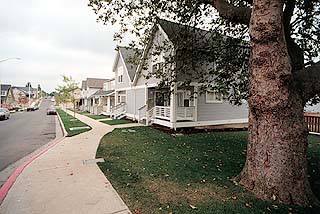
A: Holly Park is a remarkable example of taking 100 acres and trying to develop a mixed income community with subsidized rental and subsidized for-sale housing. It’s got a whole group of social agendas tied to it, including a community supported agricultural program. Our involvement has been to develop the open space system, with our partner Nakano and Associates, through the master planning effort. We have been handling the residential side of the open space system and the community center, and community supported agricultural component and Nakano has been doing the streetscape environment as well as the major public parks. It’s been a wonderful collaboration.
Q: What percentage of your work is public and private?
A: Probably 60 to 70 percent of our work is public, the balance is private. The private work tends to be things like private academies, educational facilities, religious facilities and a little bit of residential. I don’t have a real distinct preference. What I do care about is that most of our clients are involved not only in their own phsyical facilities but they are concerned about their place within a larger community.
|
A: You go back to the content of the community’s activities and look for a way in which to integrate it with the physical environment in which they are choosing to develop.You want to allow people that transition from their day-to-day harassed lives into an environment where they can have some reflection, put things in a larger context which is engaged in the real environment in which they live. So there is both an integration and a separation, which I find fascinating.
Q: Do you see any trends in your industry?
A: One of the trends I’m seeing, and it’s not a new one but it’s continuing to mature, is that of multidisciplinary collaboration. And that is a source of great pleasure for me. I think it’s fair to say there aren’t single discipline problems we’re facing. I think almost all of them demand multiple discipline solutions. That means working with architects, engineers, wetlands biologists, foresters, sociologists, historians, artists, you name it. For example, the Civic Center is a classic example. It is a place where the culture of the city ought to be reflected. If you can be smart about the way you structure and manage the product you can get a richer physical and long-term solution. That I find very interesting. As a firm it’s something we’ve all pursued.
Q: What keeps you interested in landscape architecture?
A: One of the things I find the most engaging about landscape architecture and urban design is the materials you work with - whether they are people at one end, or stone at the other, or climate or complexity of soil nutrients. What I’m seeing is that increasingly, through this multidisciplinary collaboration, the boundaries between disciplines are not breaking down but the edges are blurring and you see the overlap of disciplines.
Previous columns:


