 |
Subscribe / Renew |
 |
Contact Us |
| ► Subscribe to our Free Weekly Newsletter | |

Construction Bids
| home | Welcome, sign in or click here to subscribe. | login |


 print print  email to a friend email to a friend  reprints add to mydjc reprints add to mydjc |  |

December 29, 1999

By SAM BENNETT
Journal Staff reporter

|
Q: What type of work does your firm do?
A: We are doing, primarily, work for private clients — commercial and residential mostly. We have, on occasion, done institutional work. The types of projects range all over the map; it just depends entirely on what our client base needs, so we find ourselves doing things from retail to tenant improvements to kitchen remodels.
Q: Do you have a particular design style you adhere to?
A: Architects typically will have a given style that they like to work in, but our focus is on providing specific services to individual people. Every one of our clients has different tastes. They have a different style of their own, so we find ourselves doing classical restoration projects and ultramodern interior design work, contemporary homes and mixed-use projects. We work within the context of whatever it is we happen to find ourselves in. Sometimes it demands something that's contemporary, and sometimes it demands something that's traditional.
Q: What are a couple projects you are fond of?
A: We have a new house that is in the design stage now, that's going into Madison Park. It's totally unique for me because it's on a flat site. It's about the first flat site I've seen in 10 years. It's a kind of shingle-style home, and it's been a lot of fun working on. This particular location is a large site and is fairly well hidden by vegetation from most of the things that are going on around it. It can afford to be pretty much whatever it wants to be. The client's tastes tend to be on the more traditional side — the shingle-style sort of vernacular, which fits wonderfully in there.
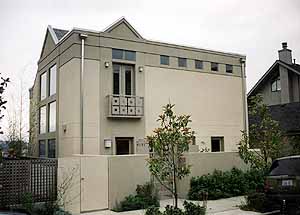
At the same time, we are working on some commercial rehab projects. One of them is going right into the downtown area in Kirkland. The general feel of the downtown Kirkland area is very vibrant, very contemporary and the design for this is real jazzy. We're rehabbing the exterior of a small commercial space to attract a new tenant. My own vision of how that corridor is coming together is very exciting. There is a strong character, with very contemporary high-design storefronts. It's a very unique neighborhood, I think.
|
A: A lot of metal, a lot of glass — the shapes tend to be dynamic rather than static. For instance, the marquee, in a lot of cases in more traditional work, is flat and very staid looking. In more contemporary ones, they can be sloped at a sharp angle, they can have pointy things sticking out of them like metal and glass features — very futuristic and a lot of fun.
Q: With your residential work, it sounds like you're not looking to make bold design statements.
A: No, we have really found that by and large, the design situations that we have been in have not called for that kind of thing. By all means, if we found one that did, we'd jump at the chance because it's always fun to make a huge statement of some kind. But, on the other hand that's not something we're willing to force on somebody who doesn't want that.
Q: What kinds of materials do you prefer to work with?
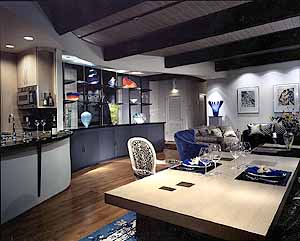
A: We really work in whatever seems the most appropriate, so we've used some stone and brick occasionally. We're using a lot of stucco and some specialty materials that are like marbleized stucco. I like that stuff a lot because it looks a lot more interesting than a typical flat surface. But we use a lot of wood, too.
|
A: Almost every residential remodel that we work on involves providing new kitchen and family rooms in an old house that never had one, new home office space for one or both working adults and very sophisticated gourmet appliances. It's because the old housing stock never had that. It's just the way we're living now, and the family structure has changed so much in the last 20 years or so that people have to have those kinds of spaces.
Actually, the most interesting trend I've noticed is not necessarily to do with space, but with materials and investment. I think the perspective on where people are investing their money has changed. We're starting to see a much greater interest in strong, more permanent materials and a stronger recognition that while those materials might be more expensive in the short run — during the initial construction — over the long haul they probably work out to be less expensive because of the lower maintenance.
Q: What's causing this trend?
A: I think it probably is a function of having the funds to do a little more than we used to. There is a little more flexibility now. We've gotten to the point where it's more than just getting in the door. Let's think about 20 years from now, and what we're actually going to be spending in two years if we have to re-paint the thing.
Q: Who are your influences?
A: We're not above stealing from anybody. Because we work in so many different vernaculars, we will use resources from everywhere. Right now we're working with a client who loves Green and Green, a couple of brothers from around the turn of the century. It's sort of the epitome of the Craftsman, shingle-style bungalow. We had a client a couple years ago who really loved the Capitol Hill Mansion style and had a site in Laurelhurst that had a little '40s house on it. We studied Capitol Hill mansions for a while and ended up doing something that I think would be very comfortable on Capitol Hill, and it looks wonderful in Laurelhurst.
Q: What keeps you going as an architect?
A: The people. I have had such an incredible amount of fun working with my clients and helping them find the right thing to do for whatever it is they wanted to do. It's very rewarding. They get so excited when they see something that's just exactly what they wanted, that it keeps me coming back. I could do this forever.
Previous columns:


