 |
Subscribe / Renew |
 |
Contact Us |
| ► Subscribe to our Free Weekly Newsletter | |

Construction Bids
| home | Welcome, sign in or click here to subscribe. | login |


 print print  email to a friend email to a friend  reprints add to mydjc reprints add to mydjc |  |

November 17, 1999
By ANNU MANGAT
Journal Staff reporter
|
Q: What does your firm do?
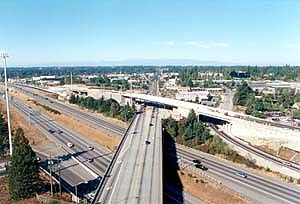
A: We are civil and structural engineers, planners and surveyors. We work across a number of market areas in both the public and private sector, including airport facilities, waterfront facilities, streets and highways. We also do site development, master planning and surveying.
| "We have to start ... making some hard decisions about cost and benefit [regarding the Endangered Species Act] and whether we have enough scientific knowledge to be so positive about pronouncements, about seeing things in black and white." |
Q: Is Initiative 695 affecting your firm?
A: So far, we're taking a wait-and-see attitude. There's no question that there is an immediate impact on the state's transportation budget.
The budget that was passed last year reflected a significant increase because of Referendum 49; I-695 has taken that increase away. The state has been underfunded for a number of years in transportation; we still have a pretty significant highway and street practice in spite of that.
Q: What markets are really active right now?
A: Our structural engineering practice is growing dramatically. We have done for 40 years a significant amount of structural design for waterfront facilities -- it's a key part of our practice and an area that is growing.
Recently, we've been doing a great deal of on-call, peak-load plan review for public agencies in the Puget Sound region. We have also picked up some seismic retrofit work and plan to grow that area.
Q: What are the challenges facing your firm?
|
I think there's an ever-increasing speed of delivery. That puts a burden on us to make sure that we're still providing the same level of service and quality that we've always expected to provide.
The other side of that is that electronic tools like e-mail have really helped us in terms of improving communication efficiency, but at the risk, perhaps, of causing us to try to produce and deliver product more quickly.
Q: As a professional engineer practicing in the Puget sound area for 16 years, what industry changes have you observed?
A: There is a much more open attitude and much more willingness of competitors to collaborate than you saw 10 or 15 years ago. The size and complexity of certain projects probably drives part of that.
Another industry change has to do specifically with materials. For example, when I came to the Puget Sound region, if I raised the question of geotextiles with many clients, they thought that I was probably a little too far out to be working on their project. If our folks didn't know what geotextiles were now, they probably wouldn't be qualified for the work.
The other dramatic change that we see has to do with the process of getting projects approved -- getting funding assembled, getting through the permitting process, getting through the community process. That whole arena has gotten more and more time-consuming.
Q: Is the pending Endangered Species Act listing for salmon having an effect on your business?
|
There are certain parties who have staked out positions and are unwilling to give any ground. I don't think we'll make any progress until we make compromise. Regulation seems to be a lot easier to accomplish than changing habitat, so maybe increasing the complexity of the regulatory process appears to be the easiest solution, but I'm not sure it will be in the long run.
Q: What is one of your firm's projects that you're particularly proud of?
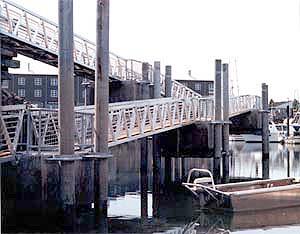
A: The Port of Everett asked us to develop a facility that would comply completely with the Americans with Disabilities Act. We did that, and, in the process, our folks had to do some pretty original thinking. We had to come up with a way to design ramps that would move with the tide but also stay within the slope requirements of ADA. It's an attractive project, and we received an award from the Washington Coalition of Citizens with Disabilities. It's not a big, glamorous project, but it's one where our people just dug in and did some good hard work to come up with a good design.
Q: What do you like best about your job?
A: At this stage in my career, what I really like best is trying to find creative ways to put teams together to solve clients' problems, figuring out who the right people are, the right firms to bring together on a team and then figuring out a way to explain that to a client so that you end up winning the job and doing a good job for them.
Previous columns:


